
Leaflets on Arboriculture and Tree Care
They were designed to assist you in your arboriculture projects, whether it is for hiring an arboriculture contractor, planting a tree, or pruning and maintaining your trees.
These documents are available for free in PDF format. Click on the image to download the leaflets.




Other resources used with permission
The law explained by Éducaloi - Trees and fences Éducaloi
Tree resources Arbres Canada
Trees, insects and diseases of Canada's forests Natural Resources Canada
Exotic forest insect guide (ACIA)
30 years of pruning with Charles Moreau (From the February 2008 issue of Québec-Vert magazine)
Fruit tree pruning and the arrival of spring
Two professions side by side: horticulturist and arborist... what's the difference?
Visual awareness of tree condition (11 MB)
Visual document on the condition of urban trees created by Bernard Blareau for the Centre du Paysage ASBL (Europe). This downloadable visual file is essential for raising awareness among tree managers and businesses about the living conditions of urban trees to guide their choices!
Important
Some texts cited in reference were published several years ago. Although the general data remain the same, some have changed, especially the rates.
In 2024, the cost of hiring a team of skilled pruners may range around $250 to $300 per hour. You might find cheaper... but keep in mind that to cut prices, security and service quality have probably been compromised.
Terms Related to Arboriculture
To help you understand the various terms used in pruning, here are some definitions of the work generally carried out in arboriculture.
First, the term "limber" or "limbing" is no longer used. We rather talk about pruning work. This work is carried out by pruners, workers who hold the best knowledge for properly maintaining your trees. The pruner is actually the practitioner.
The arborist is the manager who possesses the knowledge to oversee the management of the tree heritage. He may also have pruner training, in which case he is called an arborist-pruner.
ARBORICULTURE GLOSSARY
TREE FELLING
Operation that consists of removing an entire tree from the ground.
ARBORIST
Professional who possesses the technical skills, acquired through experience and appropriate training, to ensure or supervise the management of trees and other woody plants in residential, commercial, and public settings.
SHREDDING
Shredding is the action of chipping branches and sometimes the trunk of a tree into chips. This operation is carried out using a chipper.
PRUNER
Person possessing the technical knowledge and abilities to perform arboricultural work safely.
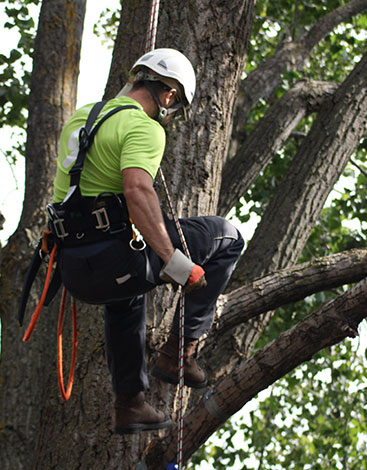
CLIMBING PRUNER
Person possessing the technical knowledge and abilities to perform high-altitude pruning work in trees safely.
LOPPER
Person whose job is to remove new shoots from a tree originating from dormant buds. The term lopper should not be used today. It is considered an old term used to describe someone who prunes trees. Instead, "pruner" should be used.
LOPPING
The term "lopping" should no longer be used in arboriculture unless the only operation performed on a tree is the removal of suckers. It is a complementary operation to pruning, which consists of removing only new shoots or suckers appearing on the lower half of the tree trunk that originate from dormant buds. Today, work done on trees involves pruning.
PRUNING
Pruning is a technique that involves cutting, reducing, or removing branches, shoots, roots, flowers, or fruits from a plant to improve the structure, clearance of infrastructure, as well as vegetation, flowering, fruiting, shape, ornamental appearance, and health. A common synonym for pruning is trimming. Often wrongly called lopping, pruning is a common and necessary practice in urban areas. Your arborist will be able to propose the best work to be carried out on your tree, according to its needs.
- Safety Pruning: Pruning that involves removing dead, diseased, weak, or broken branches, as well as those that pose a potential danger to people and property.
- Directional Pruning: Pruning aimed at trimming and redirecting branches that could affect or hinder overhead public utility networks or other structures while keeping well-oriented branches in place.
- Thinning Pruning: Pruning that involves removing some of the branches on the framework to aerate and lighten the tree's canopy without changing its shape. This type of pruning allows for better sunlight on your property.
- Sanitizing Pruning: Pruning that involves removing dead, diseased, interfering, harmful, broken branches, etc., to maintain the tree in good condition. This type of pruning also includes the control of stubs, suckers, and regrowth.
STUMP REMOVAL
Operation that consists of removing stumps from a terrain that remain after tree felling. Different types of stump removal exist, either chipping or extraction.
Chipping stump removal is carried out using a stump grinder, to reduce part or all of the tree stump into chips. The tree residues that remain on the ground will decompose in the soil over time. This technique is often less costly and also less damaging to your terrain.
Stump removal with a backhoe allows complete extraction of the tree stump and its attendant roots from the ground.
CABLING
Cabling is a technique that involves installing cables or rods in a tree's structure to provide additional support to weakened branches and forks. Different types of cabling exist, including flexible and rigid cabling. Your arborist will be able to advise you on the best system to install if needed.