
FREQUENTLY ASKED QUESTIONS BY THE CONSUMER
This section is constantly evolving. Currently, we have included some answers that frequently come up. Many of the questions we receive can be answered by consulting our brochures, which are available for free under the “Documentation Centre” menu.
The program leading to the DEP in "Pruning" is offered in 4 training centers in Quebec. Here are the contact details:
- Centre de formation horticole de Laval
1051, croissant Pierre-Bédard, Laval (Quebec) H7E 1Y8
Tel.: (450) 662-7000 ext. 2201
- Centre de formation Fierbourg
800, Place Sorbonne, Charlesbourg (Quebec) G1H 1H1
Tel.: (418) 622-7911 ext. 7740 - Centre de formation professionnelle du Suroît (Des Moissons)
260, rue Gagnon, Beauharnois (Quebec) J6N 2W8
Tel.: (450) 225-1084
- École forestière de la Tuque
461, rue Saint-François, La Tuque (Quebec) G9X 1T8
Tel.: 1 (866) 676-3006
Several factors can influence the cost of pruning or felling work. Among these factors, we note, among others:
- the type of work to be done
- the scope of work
- Is it an emergency situation
- Where is the tree located and are there any obstacles around the tree
- What is the size of the tree
- What is the health condition of the tree
- Is the use of specialized equipment such as a lift or crane necessary
It is therefore impossible to provide an exact price without visually evaluating the work to be done. It should be considered that being an arborist is a high-risk profession. The riskier the job, the more the contractor needs to protect themselves.
Arboriculture standards require teams to have at least 2 workers trained in aerial rescue. As a general rule, the contractor will provide a flat rate to their client and will plan their schedule in order to reduce fixed costs (Team travel, unloading of branches and trunks, etc.). The contractor will try to serve multiple clients in the same area to benefit their client.
The following factors must also be considered when determining the hourly rate:
- Does the contractor have their equipment inspected regularly?
- Do the employees work with safe machinery?
- Do the employees have all necessary personal safety equipment?
- Are the equipment renewed regularly for workers' safety?
- Are the workers covered by the CNESST, classification unit "Arboricultural Work"?
- Are the workers' wages declared?
- Does the contractor hire qualified workers (Professional Studies Diploma in Pruning)?
- Does the contractor have liability insurance?
- Does the contractor possess professional error and omission insurance?
All these factors will influence the contractor's hourly rate. A contractor who pays for an annual inspection of their lifts, provides personal safety equipment to their workers, possesses all well-maintained chipping and stump grinding equipment, etc., declares wages, offers employee benefits, and much more will necessarily have to charge more than one who does not pay CNESST contributions and hires workers under the table.
Never forget that it is the contract issuer (client) who is responsible in the event of an accident. It's always better to pay a little more but hire a good, competent, and conscientious contractor. A detailed invoice will also attest to the work performed and will protect you in case of a dispute.
Download the brochure "Why Hire an Arborist" from the "Documentation Center" section for more details. For hiring a contractor, you can consult the list of our commercial members.
Several companies perform transplantation. However, the bigger the tree, the more complex the operation becomes and requires specialized equipment. Consult the list of our members to find a company that can perform this type of work.
It is impossible to provide a diagnosis by phone or even by email. You need to contact an arboriculture consultant who can assess your tree and provide possible solutions. If he cannot treat your tree himself, he can recommend a contractor or specialist who can perform the work. Check the list of our members to find a company that can perform this type of consultation.
Disputes between neighbours generally require a written assessment of damages and/or a report from a consulting expert. It is therefore impossible to provide information by phone or email. You need to consult with an arboriculture consultant or a forestry engineer who specialize in this type of case. They will be able to provide the necessary advice and explain your rights and obligations. Check the list of our members to find a company that can conduct this type of consultation.
The law concerning trees and fences: Éducaloi
The monetary evaluation of a tree is often necessary to establish an accurate value for the tree. It may be requested following an incident or due to a dispute with a neighbour or a contractor. Several factors can affect the value of your tree. First, its species, its location on your property, its condition, the neighbourhood, the environment, and many other factors specific to each case. Therefore, it is impossible to provide an evaluation over the phone or email simply with the tree species.
The monetary evaluation is conducted by a consultant who has in-depth knowledge of this subject. You need to reach out to an arboriculture consultant or a forest engineer specializing in urban forestry. The consultant can provide you with more information on establishing a monetary value. Check the list of our members to find a consultant who can perform this type of evaluation.
The information for the process to become an entrepreneur authorized to work near the electrical network is available on the Hydro-Québec website at the following address:
Myths and realities about trees
While trees can generally take care of themselves in forests, in urban environments such as your yard or community, trees need protection and proper care. Each year, these persistent and insidious myths are responsible for many costly and sometimes dangerous mistakes in tree care.
Myth: Trees can break sewer pipes.
The roots are attracted to sewer pipes and can break and perforate them.
-
The reality…
The underground pipes are often broken by wear over time, by weather action, or by freeze/thaw cycles. They can be broken, defective, misaligned, and non-watertight. Tree roots are unable to split pipes. The roots present in the drains are small and tender, and they hang from the top of the pipe. They can take advantage of existing leaks that let liquid escape. Without these leaks, drains covered with watertight sand seals are not attractive to roots. When there are open and non-watertight joints, nourishing gases escape from the network and slowly rise to the surface. Roots can therefore gradually develop towards the pipes by taking advantage of the leaks. They penetrate through the existing openings (cracks).
Myth: Roots can break the foundations of a house
-
The reality…
Tree roots cannot survive in sterile environments like concrete, and they will never try to penetrate the walls of a foundation. On the contrary, roots will seek out moisture and could enter pipes (or foundations) that have leaks or cracks in search of moisture.
Roots are devoid of water detectors. They don't need them because they grow and proliferate where they enjoy favorable conditions. Trees, therefore, do not waste their energy seeking water. Root growth is opportunistic. The tree normally spreads and distributes its roots under the soil surface, where there is air, water, and minerals. Therefore, it has no interest in invading the soil too deeply. More than 90% of tree roots are found in the first fifty centimeters of soil. A tree's roots can spread over a radius that can measure between one and two times its height. Several factors can cause cracks in a foundation. The use of certain soils to backfill buildings, the transfer of surface water from roofs and driveways into storm sewers, prolonged periods of drought, and the removal of large quantities of soil in areas where trees are present. All these factors can contribute to soil retraction and foundation lifting, causing cracks.
Myth: As they grow, tree roots are capable of lifting sidewalks to develop.
Roots are often responsible for the lifting of sidewalks, paving stones, and alleys.
-
The reality...
Many sidewalks are broken or lifted by wear over time, by climate action, by freeze/thaw cycles, by the movement of heavy machinery (during snow removal), or due to poor construction quality. When breaking, sidewalks automatically lose some of their solid appearance. During the first stage of roots' growth, the new tissues occupy the space left free by the sidewalk's displacement. These more or less gelatinous tissues are incapable of exerting pressure on anything. Instead, they mold to the objects they come into contact with. During the second and final stage of growth, the same tissues harden in their formation position and turn into wood. From then on, the sidewalk can no longer return to its original position. It is always preferable to avoid moving heavy machinery over sidewalks. When constructing a sidewalk, make sure the base is solid, deep, and stable. For a private sidewalk, it's better to bypass the roots.
Myth: Trees have deep roots
Most trees start their life with a taproot - a straight tapered root that grows vertically downward and from which other roots grow. Over time, the roots will dig very deep into the ground and remain primarily vertical.
-
The reality…
Most trees do not have a taproot; they tend to be shallower than you think. While some trees have a taproot when they are young, after a few years, the main root system becomes widespread with primarily horizontal surface roots and only a few downward-growing anchoring roots.
Tree roots need to be shallow to stay in the loose, aerated soil near the surface. They extend several times the width of the canopy. Root damage is a major cause of decline, death, breakage, or failure. Certain actions or phenomena like soil compaction, soil removal, root cutting, backfilling over roots, flooding, or drought could compromise the condition of the tree's root system and cause its decline.
Myth: Tree wounds need to be covered with sealant products.
Like animals, trees can be injured. Covering the wound with paint or filling a cavity with material will speed up and complete the healing process.
-
The reality...
Unlike animals, trees do not have a healing process. Healing means returning to a healthy state, repairing, or replacing injured tissues. Trees, with their rigid cell walls, are unable to heal injured or infected tissues. Instead, trees will cover or isolate damaged tissues rather than heal them. When the bark of trees is damaged, microbes attack the plant tissue, and trees respond by creating walls around the tissues. This process is called "compartmentalization" and occurs when the tree constructs four walls around the injured area to preserve the rest of the tree. The survival of the tree will depend on the tree's success in compartmentalizing the wound.
Research demonstrates that sealant products do not stop decay or rot. Trees respond effectively to their injuries without the aid of additional chemicals. Therefore, one should not interfere with this natural process by applying household paint, wood preservation products, or heavy layers of any material to a wound. Keep your tree healthy, and it will take care of its wounds. In no time, the surface of the wound will blend seamlessly with the tree's bark.
Myth: Prune branches flush with the trunk.
Pruning is often done to remove dead wood from a tree, to clear ground space, and to remove interfering branches or to balance weight. To ensure no stubs remain on your tree, cut the branch as close as possible to the trunk.
-
The reality...
The branch collar, which is the part of the branch that meets the trunk, must remain intact for the tree to stay healthy. Cutting a branch too close to the trunk removes the collar, which leaves the tree vulnerable to pests, decay, and disease.
Myth: Topping is a good choice.
When a tree becomes too large, it is appropriate to remove all the highest branches to ensure that the tree does not interfere with the view, sunlight, or surrounding structures.
-
The reality...
This practice called "topping" is completely unacceptable. It violates all accepted pruning practices. A topped tree is weak, vulnerable, and deprived of the nutrients from its leaves, leading to weak branches, vulnerability to pests, decay, and disease. Additionally, a topped tree is much more expensive to maintain, is not visually appealing, has weakly attached branches that will become even larger than the original branches and can break very easily, even with a very light wind. Topped trees often need to be removed because they become dangerous.
Whenever topping is considered, there are two acceptable alternatives:
Contact a commercial member of the SIAQ to learn more about crown reduction (a safe alternative to topping).
Remove the tree and replace it with an appropriate tree for the location.
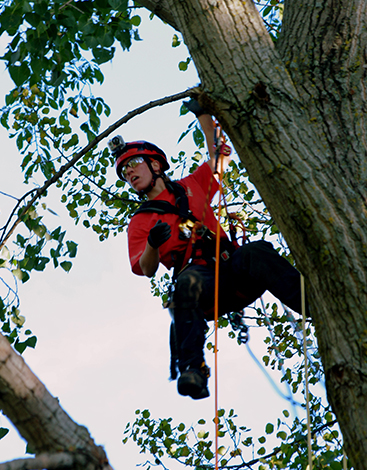
Photo: Luc Belcourt