Know how to choose your arborist and learn more about the services they can offer, as well as the benefits of hiring a professional certified by ISA or another organization.
The arborist is a tree specialist. They know their needs, have received relevant training, and possess the proper equipment to provide the necessary care. Hiring the services of an arborist is a decision that should not be taken lightly. Properly maintaining your trees is an investment that can prove very profitable. Well-maintained trees are attractive and can increase the value of your property. On the other hand, neglected trees can be dangerous. Pruning or felling involves risks, especially when it comes to large trees. This work should only be entrusted to specialists who have the training and equipment to work safely.
On this page, you can consult the following sections:
The services offered by arborists
How to choose the right arborist
PRUNING
An arborist can determine the type of pruning needed to improve the health, appearance, and safety of your trees. The different pruning methods include the removal of branches:
- that interfere with facilities or buildings
- that obstruct streets or sidewalks
- that are diseased or infested with insects
- that are damaged during a storm
Other pruning methods are used to maintain the natural structure of young trees, improve their shape, and reduce the likelihood of damage caused during storms.
FELLING
Although used as a last resort, felling may be necessary in certain situations. An arborist can help determine if a tree should be felled. Felling is recommended if the tree:
- is dead or dying
- presents an unacceptable risk
- causes an obstruction that cannot be corrected by pruning
- is growing too close to more desirable trees and inhibits their growth
- needs to be replaced with a tree that is better suited to the site
- needs to be felled to make way for new construction
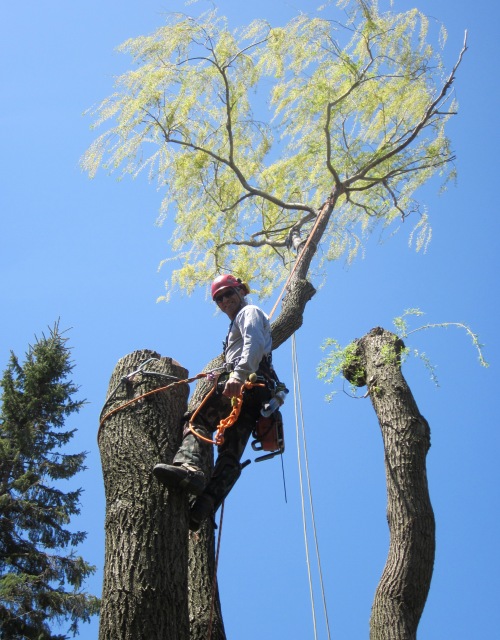
Photo Julien Dansereau
EMERGENCY WORK
During storms, it often happens that branches or entire trees fall and damage other trees, buildings, or vehicles. Given the considerable weight of these trees, it can be dangerous to attempt to move or cut them. An arborist specialized in pruning work can perform this job safely, while reducing the risk of further damage to the property.
THE PLANTATION
Some arborists carry out planting work and can mostly recommend species adapted to a specific location. Planting a wrong tree in a wrong place will lead, in the future, to problems related to space constraints, insects, diseases, or poor growth.
OTHER SERVICES
Many arborists also offer a variety of other services, including:
- Plant health care or preventive maintenance to keep trees healthy and reduce problems related to insects, diseases, and site conditions
- Fertilization and soil modification to improve tree health
- Cabling to strengthen weak branches
- Soil aeration to improve root growth
- Installation of lightning protection systems
- Application of treatments to control certain insect and disease infestations
- Consultation and legal expertise services related to trees
HOW TO CHOOSE THE RIGHT ARBORIST
Check if the arborist is a member of a professional organization such as the International Society of Arboriculture-Québec (SIAQ) or another arboriculture organization in your area. Membership in a professional organization demonstrates the arborist's interest in staying informed about the latest techniques and findings in the field.
Check if the arborist holds certification from the ISA or another professional organization, such as those offered by government or private agencies. Certified arborists are experienced professionals who have passed an exam covering all aspects of tree maintenance.
Require proof of insurance and verify its validity with the insurance company. A good arborist carries liability insurance for damage to people and property, in addition to workers' compensation insurance (if applicable in your area).
Check for mandatory permits and licenses. Some municipalities require contractors to obtain a permit or apply for a license before they are authorized to work.
Ask for references to verify if the company has completed similar work to yours. Feel free to check these references or visit the sites where the contractor has already performed work.
Unless you are already satisfied with the first bidder, ask for additional quotes. You may have to pay for the assessments, and the process will take longer, but ultimately the investment will be worth it.
Do not necessarily accept the lowest bid. Compare references and different bids, and determine the best offer based on these criteria: price, work to be done, skills, and professionalism.
Be wary of contractors who go door-to-door and offer to do the work at a discount. The most reputable companies have schedules too busy to solicit work this way.
Keep in mind that good arborists only apply techniques that conform to industry standards. For example, topping a tree, excessive thinning, using climbing spikes on trees that will not be cut down, as well as unjustified felling and pruning, are all unacceptable practices that violate industry norms.
Request a written quote. The most reliable arborists sign a contract with their clients. Make sure to read the contract carefully and do not hesitate to ask questions such as:
- When will the work begin and when will it be completed?
- Who will be responsible for cleaning up the site?
- Is the listed price the total price?
- What are the payment terms?
- In case of additional work, what is the hourly rate?
WHAT IS AN ISA CERTIFIED ARBORIST?
An arborist is, by definition, a person who is skilled in planting, caring for, and maintaining trees. The certification of arborists from the International Society of Arboriculture (ISA) is a non-governmental and voluntary process through which individuals can demonstrate their level of knowledge. It is an internal process administered by the ISA and is not governed by any law. Certification allows for the assessment of individual knowledge and skills to provide appropriate care for trees.
Certification does not assess the application of best practice standards. Certification attests to a person's arboricultural knowledge but cannot guarantee the quality of work.
ISA certified arborists are individuals who have achieved a level of knowledge in tree care through their experience and by passing an exam designed by some of the leading experts in arboriculture. Certified arborists must continue their education to maintain their certification. Therefore, it is highly likely that they stay informed of the latest arboricultural techniques.
BE AN INFORMED CONSUMER
One of the best ways to choose your arborist is to learn about the basic principles of tree care. That's why the ISA offers a series of tree care brochures on this subject. For more information, your garden center staff or a consultant-arborist are excellent sources of information. They may be able to recommend an ISA-certified arborist in your area.
Find an Arborist
Do your trees need maintenance?
SIAQ does not offer consultations. For advice or work to be done on your trees, you need to contact a contractor. Check our member list to find a professional near you.
Quebec now has over a hundred ISA certified arborists. You can visit the ISA website (in English) to find a certified arborist near you.
Looking for an ISA certified arborist?
ISA provides a search tool on the "Treesaregood.org" website. This site is external to the SIAQ website and is in English only. To find a certified arborist in your area, click on “ Find an Arborist ”
This list only contains the names of certified arborists who are available to perform work. Some certified arborists have chosen not to be listed.
To verify the status of an ISA certified arborist
If you wish to hire an ISA certified arborist and want to validate their certification status, you can verify it with this database on the "Treesaregood.org" website. This site is in English only.
Click on “ Verify a credential ”
Make sure to write the name exactly, because otherwise, the result will not be conclusive. If you're unsure about the spelling, try several ways. If they have provided their certified arborist number, it could facilitate your search. Don’t hesitate to ask them.
Did Hydro-Québec refer you to SIAQ to prune a tree near low-voltage power lines?
Are your tree branches touching the wires from your power entrance or the low-voltage lines? To have it pruned, you must contact a tree work contractor. No need to call us, we don’t provide any phone references. Instead, consult the list of our commercial members according to your region. These professionals are best suited to answer your questions.
If your tree or its branches are less than 3 meters from medium-voltage power lines (the medium-voltage line is the small bare wire located at the top of the poles), only specialized contractors can perform this work. These contractors have received special training to work near these power lines. You must therefore contact an authorized Hydro-Québec contractor. You can find them in our professional search tool. Make sure to check the “Work near the electrical network” box to get the list of specialized contractors.
Not sure you can accurately distinguish the wires? Visit this section of the Hydro-Québec website to learn how to recognize dangerous wires. Learn more