Prescription Pruning Workshop
Workshop in English / Formation en anglais

Instructor: Lindsey Purcell
Lindsey is an Urban forestry specialist, arborist, author and principal of Lp Consulting Group LLC. He has been involved in the community landscape and urban forestry industry for over 40 years. As an ISA Board Certified Master Arborist, he has served communities around the U.S. as a landscape and tree professional in state, municipal and private enterprise. In his role as a presenter, freelance writer and author, Lindsey continues to provide many instructive opportunities and products for professional arborists and urban foresters on a national level. His educational background includes an Associate of Science degree from Vincennes University, a Bachelor of Science degree from Purdue University and a master’s degree from Indiana State University. Lindsey serves as Executive Director of the Indiana Arborist Association and former extension specialist and instructor for Purdue University Forestry and Natural Resources. Lindsey is an ASCA Registered Consulting Arborist and holds the ISA Tree Risk Assessment Qualification as a certified instructor by the International Society of Arboriculture.
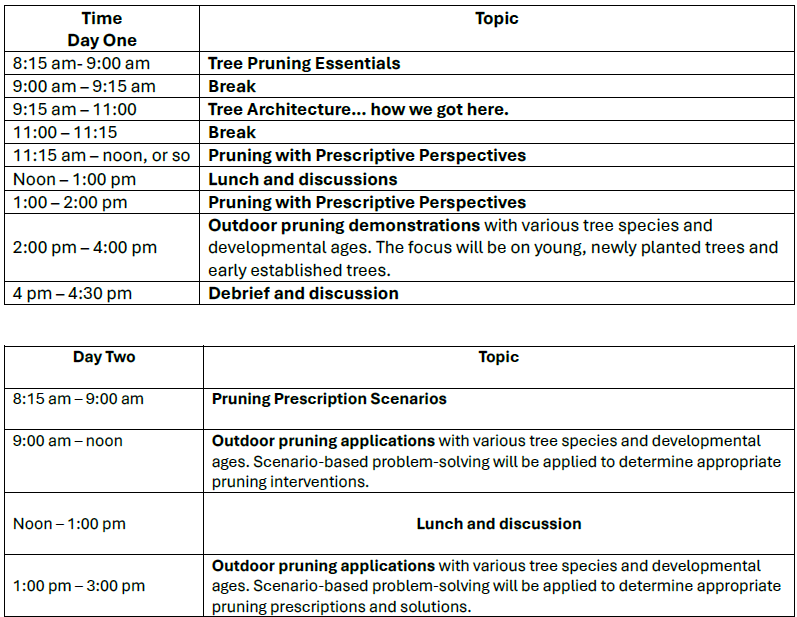
This Tree Pruning Series is a modular training system designed to provide learners with a comprehensive overview of pruning interventions for deciduous trees in urban environments. The curriculum covers topics such as the physiological effects of pruning, decision-making guidelines based on current standards, biomechanical considerations, and prescriptive pruning using written specifications. Single-day programs offer participants an in-depth 4-hour course, featuring a short outdoor practicum with demonstrations in the afternoon. The 2-day programs add another outdoor demonstration and provide hands-on pruning practice including writing and implementing pruning prescriptions.
Workshop Content
This module addresses the key considerations for implementing pruning cuts that promote optimal tree structure and health. Although pruning is sometimes referred to as "one of the best, worst maintenance practices" for trees due to its significant influence on plant physiology, proper execution is critical. Participants will gain an understanding of correct techniques, determining pruning dose, and the overall response of pruning. The presentation provides essential guidance aligned with best management practices and current research to enable more effective pruning decisions.
Trees with well-developed branch structure tend to be more resilient and less prone to failure. This module reviews the differences between strong and weak crown architecture, showing how these forms develop from the nursery through maturity in the landscape. By learning to identify various branch structures, arborists can make informed decisions and take steps to minimize the risk of tree failure.
Mastery of appropriate pruning techniques and understanding tree response are essential for sustainable tree plantings. Equally important is the clear communication of the pruning strategy to both the tree owner and the arborist responsible for the work. Written prescriptions serve as a vital tool for outlining the specific objectives and anticipated outcomes of pruning activities. This module introduces the prescriptive approach to pruning, offering a structured methodology that links the prescriber and practitioner. It ensures clear communication regarding conditions of concern, defined objectives, targeted branches, and the overall scope of work.
This module identifies the essential components of pruning prescriptions, including identifying conditions or defects requiring attention, establishing clear pruning objectives, selecting appropriate branches for pruning and determining the pruning dose. Participants will engage in virtual pruning scenarios involving trees at different stages of development, such as newly planted, early establishment, and medium-aged specimens. The focus will be on accurately identifying branches to prune, understanding proper pruning cut techniques, and formulating comprehensive pruning prescriptions for the tree.
Field-based learning differs from instruction that simply occurs in the classroom in two distinctive ways. First, field-based learning is learner-centered, where students make discoveries by engaging in a learning experience such as identifying appropriate pruning locations, types of cuts to implement and gauging tree health. Second, it is inductive, where students employ the logic and reasoning of pruning. This includes problem-solving to meet objectives while being cognizant of the biological needs of the tree. The demonstration portion of the training may be a 3-hour demonstration and pruning experience when applied to the single day option. The two- and three-day options would provide additional outdoor pruning projects which includes preparing and implementing pruning prescriptions.
Learning Outcomes
- Identify the components of tree structure that create stable, sustainable architecture.
- Compare and contrast the various pruning systems and how they differ in application.
- Identify the components of branch attachments and their significance for determining pruning cut locations.
- Classify the types of pruning cuts and explain how each are applied to execute appropriate cuts.
- Recognize the biological impact of pruning on trees and how timing and the amount of pruning influences tree health.
- Distinguish the influences of pruning cuts on trees at various developmental ages including pruning dose.
- Recognize the implication of pruning cuts and the recovery process including compartmentalization of decay in trees.
- Recognize the impacts of pruning on tree physiology, energy dynamics and biomechanics.
- Create and implement a pruning specification based on specific objectives.
- Recognize the importance of follow best management practices and the ANSI Standard, A300 Part 1.
Learning Events:
The program provides both instruction and hands-on experience when appropriate trees are accessible for field demonstrations. Although participating in field activities is not mandatory, it offers students valuable opportunities to practice research and employment skills directly. As another option, the program may be conducted on-site, showcasing demonstrations with chosen trees.
This is a modular training system which provides the learner an overview of this arboricultural intervention on
deciduous trees in the urban forest. Topics include the physiological response from pruning, pruning decisionmaking
guidelines implementing current standards, biomechanical impacts of pruning and prescriptive pruning
using written specifications. The indoor lecture is expanded to include an outdoor demonstration in the afternoon,
creating a day-long immersion into basic tree pruning science and applications. Day two will focus primarily on
pruning prescriptions and implementation on trees of various developmental stages, young trees, early
establishment and medium-aged trees.